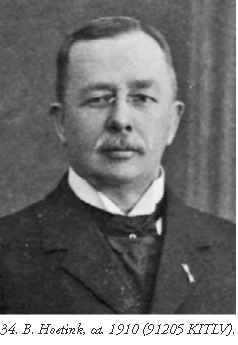
 HOETINK, Bernardus
Bernardus Hoetink was born on 27 September 1854 in Deventer and died on 6 December 1927 in The Hague. His Chinese names were Hu-ting 富亭 (Futing) and later Huding 胡定(according to Mandarin pronunciation). His name could also be written Huting 富庭(Futing). In one of his books a seal was found with his complete name 富亭印篾達裕士行一, Hu-ting ìn Bih-tát-dzū-sū hâng it, “seal of Hoetink, the eldest son Bernardus.”His father was Hendrik Richard Hoetink (Deventer, 13 May 1825 – The Hague, 21 November 1907), a baker. His mother was Johanna Stegeman (Deventer, 30 December 1829 – Deventer, 4 September 1898). Out of this marriage four sons and four daughters were born, of whom Bernardus was the third child and eldest son. The eldest daughter Johanna (1851–1902) later married H. Heukels, author of Flora van Nederland. The second son Berend Jan (1860–1928) later worked at the Ministry of Finance. The third son Hendrik Richard (1863–1922) worked as a medical doctor at the Deli Company in the East Indies from 1888 to 1902. His son, also named Hendrik Richard (1900–63), later became a well-known lawyer who taught at the University of Law (Rechtshogeschool) in Batavia (1929–34), and in 1949 became Rector-Magnificus of the University of Amsterdam. His daughter Everardina Wilhelmina (1904–45) became an agricultural law specialist. The fourth son Julius Gerardus (1865–1935) became a notary in Groningen. The other three daughters died in infancy. From October 1873, after passing the competitive examination with the highest rank, Bernardus Hoetink studied Chinese under Schlegel in Leiden together with J.J.M. de Groot and H.N. Stuart. They learned colloquial Hokkien and written Chinese. Three years later, on 23 November 1876, he entered the colonial service and was sent to China with his two fellow students. He was to study Chinese in order to be appointed later as interpreter for Chinese in the Netherlands Indies. He studied for one year in Amoy and Zhangzhou. When he finished his studies, he engaged the teacher Jo Hoae Giok 楊懷玉 from Amoy and took him to the Indies. On 13 April 1878 he was appointed as temporary interpreter (tijdelijk tolk) in Makassar. This was a temporary appointment, since Makassar was not an officially prescribed position for an interpreter. After just a year and a half, he was transferred. According to his successor Van der Spek, he had been ‘declared dead’ since he was said to be practicing the wrong kind of love (de verkeerde liefhebberij). Some of the reasons for this serious allegation were that he had good friends in China, he wished to engage a Chinese ‘boy,’ and he longed to go to China again. When Hoetink left, his teacher Jo Hoae Giok stayed in Makassar. On 28 November 1879, he was transferred to the East Coast of Sumatra, and became an extraordinary member of the Orphans and Estate Chamber. He was stationed in Medan, a new position for a Chinese interpreter in a region with many Chinese immigrants. On 5 September 1883 he was to be transferred to Padang, and would be appointed as extraordinary member of the Orphans and Estate Chamber in Padang, but one month later, on 4 October 1883, this decision was withdrawn. Instead of him, Van der Spek was now stationed in Padang, coming from Mentok. In Medan he mostly did notarial and other administrative work.From 8 March 1885 on he was a member of the Residency’s Court (Residentieraad), and from 1 July 1887 of the Landraad in Medan. He was also secretary of the Immigranten-Asyl. In 1888 he was notified that at his request he would be allowed one year of unpaid leave in China in order to facilitate the emigration of Chinese workers to Deli. At that time, J.J.M. de Groot was already trying to achieve the free emigration of workers, and his efforts met with success in 1888, but the Deli Planters now wished to send someone who was well acquainted with the situation in Deli. After a repeated request by the Deli Planters Committee in April 1889, on 23 May of that year Hoetink was charged to go to Swatow to study the languages, geography, and ethnology (taal-, land- en volkenkunde) of Southern China, and at the same time to promote direct emigration.This assignment was similar to De Groot’s in 1886, but the emphasis was on the latter task. Hoetink arrived in Swatow on 8 July, where he assisted J.H. Ferguson who was then stationed in Swatow, but who left later that month and went on leave to Holland a few months later. After a year of negotiating with various Mandarins, also on Hainan, he succeeded in arranging free emigration from Hoihow and Pakhoi (Haikou and Beihai). On 30 September 1889 he was awarded f 300 for temporarily acting in other functions in Medan, where, in addition to his own assignment, he had been acting auctioneer (vendumeester) and General Tax Collector (Algemeen ontvanger van ’s lands kas) for two months in 1887 and 1888. On 7 June 1890, in reply to his request from Swatow, he was allowed two years of leave to the Netherlands by reason of twelve years of uninterrupted service. He worked in Medan for ten and a half years, including one year in China. He left for Europe in the end of May. On 21 July 1892, he was appointed as interpreter and extraordinary member of the Orphans and Estate Chambers in Batavia.The same year, on 24 August 1892, after the Consul General in South-ern China in Amoy, P.S. Hamel, fell seriously ill and had to be repatriated, the Deli Planters Committee requested Governor-General Pijnacker Hordijk to appoint him as Consul General in Southern China. The Minister of Colonies submitted the same request to the Minister of Foreign Affairs, but without success. In May 1893 he passed the Higher Officials Examination in Batavia.Two years later, on 10 February 1894, he was willing to be temporarily appointed as consul in Jeddah, and later for the new position of Consul-General in Hong Kong, but in both cases F.J. Haver Droeze was appointed instead of him. The next year, on 27 July 1895, he was at his request honorably discharged as interpreter and extraordinary member of the Orphans Chamber in Batavia as from 31 July. The reason for his resignation is not known. Two months later, on 29 September, he was at his request reap-pointed in both of his original functions.On 26 August 1896, he was appointed as Official for Chinese Affairs in Batavia as from 1 October.On the same day, Governor-General Van der Wijck—wishing to reduce the number of Officials for Chinese Affairs—wrote to Minister of Foreign Affairs Röell that Stuart and Hoetink, who had both passed the Higher Officials Examination, might be suitable and available for an appointment as Consul in China or Singapore. On 15 October, Minister of Colonies Bergsma submitted the same proposal to Röell. Three weeks later, on 4 November, the Ministry of Foreign Affairs replied that it did not need anyone at the time. But the next year, on 10 April 1897, the latter Ministry requested information about Stuart and Hoetink, because a new Consul was needed after the establishment of a Consulate in Shanghai. In reply to Minister Bergsma, Governor-General Van der Wijck wrote that he considered Stuart and Hoetink both suitable, in particular Hoetink, who was highly appreciated by his former superiors in Medan and Batavia. As an interpreter in Medan and later here [in Batavia], he continuously remained in contact with China and kept himself informed about everything concerning China that was of importance for the Netherlands and the Netherlands Indies.But in his letter to the Minister of Foreign Affairs, Bergsma guessed that since E.D. van Walree had just been appointed Vice-Consul in Shanghai, there would be no opportunity for Hoetink, which proved to be correct.
Although this opportunity did not materialize, the next year Hoetink would have an even better chance to go to China. On 21 December 1897 and 10 February 1898 he wrote two notas requesting to be allowed to do research in China, similar to De Groot’s request of 1886 and his own of 1889. Now he wished to visit China for two years in order to continue his studies of the languages, geography, and ethnology of China, but also to make a Chinese translation of the Netherlands Indies Civil Code and Commercial Code as far as applicable to the Chinese, and to prepare an official spelling list of Chinese names.His request was granted on 3 April 1898, and as with the previous missions to China, it was combined with another assignment. On 8 May he was also ordered to promote direct emigration of suitable workers to Deli. Hoetink spent two years in China, mostly in Peking and Tientsin (Tianjin). As a result of this mission there are manuscript translations of the Civil Code book 1 and 3 and the Commercial Code for the Netherlands Indies, now kept in the East Asian Library in Leiden.On 6 June 1900, he was temporarily stationed at the Justice Department, and made inspection tours on the working conditions in various mines and plantations. On 11 March 1903, he was allowed one year of leave to Europe on grounds of long service, as from 7 April. At this time Hoetink’s career as an interpreter of the Chinese language/Official for Chinese Affairs ended after 25 years, nine of which had been spent in other locations (three years in China, three years in the Justice Department, three years on leave).In 1902 appeared the pamphlet De millioenen uit Deli, written by the solicitor J. van den Brand, criticizing the working conditions of coolies on the East Coast of Sumatra. The next year, the public prosecutor Rhemrev from Batavia investigated the local situation and published a report. Because their reports were received with a shock in the Netherlands, it was decided the Coolie Ordinance of 1889 should be revised and there should be created a government Labor Inspection Bureau. On 30 April 1904, Hoetink was charged with the revision of the Coo-lie Ordinance, and on 24 July of the same year he was appointed in the newly created position of temporary Inspector of Labor on the East Coast of Sumatra, at f 1,200 monthly. However, the revised version of the Coolie Ordinance was never put into effect, but in his report Hoetink refuted most of Van den Brand’s criticism. In 1905, at his initiative a Chinese Postal Service (Tong Sian Giok 同善局) was established in Medan to assist the Chinese living in outlying plantations in sending letters and money to China. Hoetink wrote about this initiative in “Eene Chineesche Remise-Bank.” (De Sumatra Post, 16 June 1905). The purpose of this was to facilitate correspondence and remittances and thereby also to promote emigration to Deli.
On 23 June 1906, Hoetink was at his request honorably discharged from government service as from 7 July 1906, after a career of 28 years (including three years of leave). He was a member of the Batavian Society of Arts and Sciences from 12October 1880 to 1892 [?], and again from 1 May 1894 to 1903 [?], and from 9 May 1904 to 25 June 1906. He became a member of the Board of Directors on 3 July 1894, was Secretary from 5 March 1895 and Curator (conservator) from 4 June 1895, both until 5 April 1898. On 19 December 1906, he settled in The Hague, coming from Medan. In 1907 he donated many Chinese books to Leiden University; they are now kept in the East Asian Library. His books in Western languages on China and the Indies were later donated to the Athenaeum library in Deventer.334He published several articles on the history of the Chinese officers in the Indies. From 1920 to 1927 he was secretary of the KITLV in The Hague. He remained a bachelor all his life. He passed away on 6 December 1927 in The Hague, 74 years old
====
Source: Kuiper, Pieter Nicolaas Title: The Early Dutch Sinologists : a study of their training in Holland and China, and their functions in the Netherlands Indies (1854-1900) Issue Date: 2016-02-16